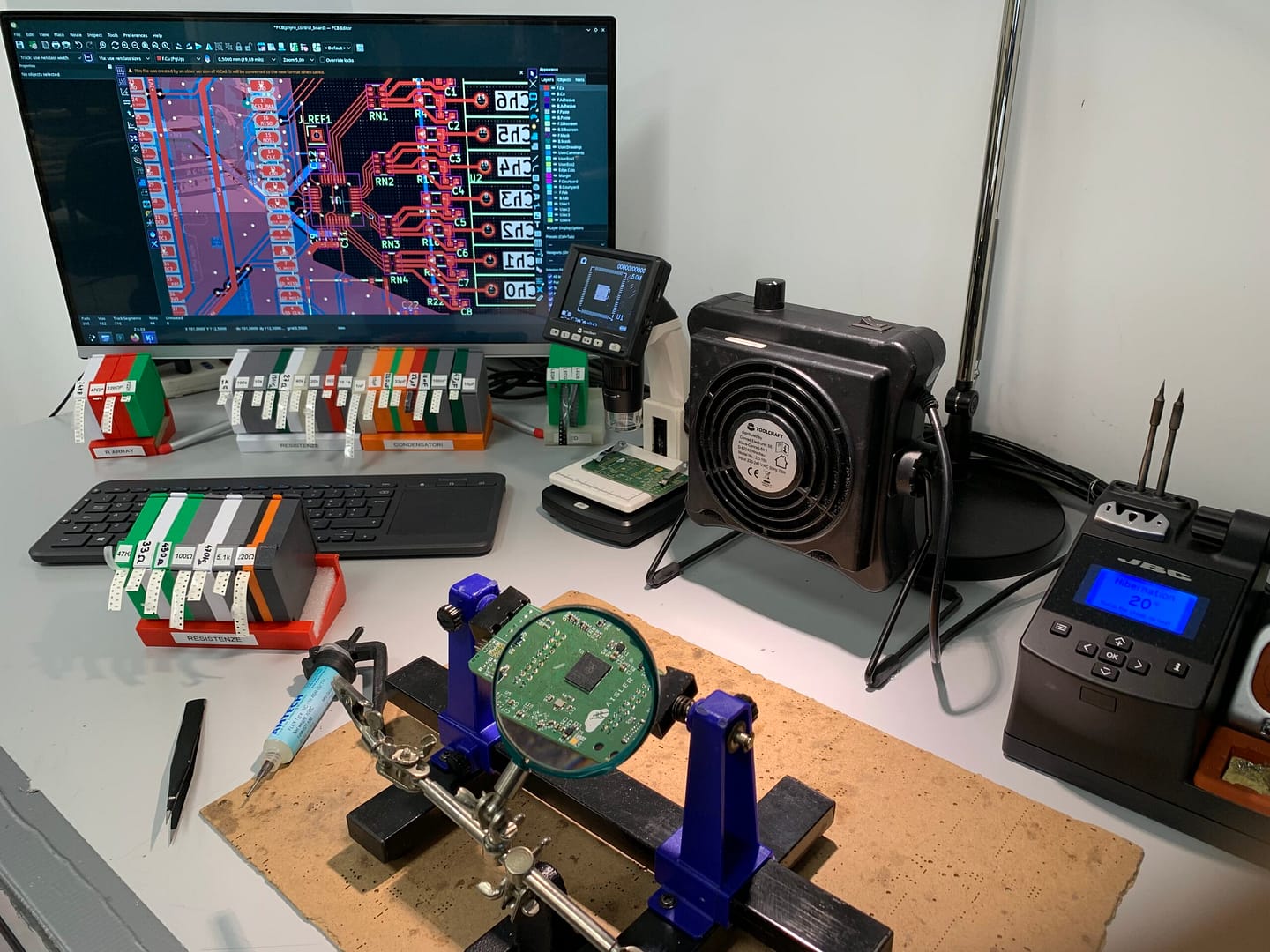
The Avionics department is responsible for the software and electronics that govern the operation of all the sounding rocket’s components during flight. It directs the selection of COTS flight computers, configuring and operating them during launch campaigns. It designs and builds the electronic boards that will be mounted on the rocket or used on the ground for motor ignition and telemetry reception. It develops the flight and ground software, along with all the scripts needed to support the team’s activities.
Topics
HARDWARE DIVISION
The Hardware division of the avionics department develops the team’s entire hardware ecosystem, personally overseeing every stage of the product life cycle: from the conceptual drafting of circuit schematics, to board layout and routing using ECAD software, all the way to component soldering and lab testing. Hardware design activities include the main and secondary flight avionics boards for data acquisition, the electronics for managing and controlling engine power, and support hardware for the ground station. In parallel, the group defines the architecture of the telecommunication and radiofrequency systems to ensure the data link between the vehicle and the ground. This includes selecting and configuring transmission protocols (such as LoRa, FSK, or LR-FHSS), sizing the link budget, and, where necessary, custom-designing antennas, both patch antennas printed on fiberglass substrate and array antennas such as Yagi-Uda.
SOFTWARE DIVISION
The flight software is the code executed by the avionics boards inside the sounding rocket. Every one of its functions is particularly critical: reading sensor data and reconstructing the rocket’s attitude are essential for triggering the airbrakes and commanding parachute deployment. Sensor data is collected onboard and saved to dedicated memory, with a selection of it transmitted to the ground via radio, allowing the team to track the rocket’s status throughout the mission.
GROUND STATION
The Ground Station is the set of electronic boards, computers, and software the team uses to display and record telemetry coming from the sounding rocket. The Ground Station is responsible for sending commands and configuration changes, from the moment the rocket is integrated and positioned on the launch rail until its recovery after flight.
TELEMETRY
The members responsible for Telemetry are tasked with designing the radio link between the sounding rocket and the ground stations. Their duties range from selecting suitable frequencies based on the team’s needs and local regulations, to purchasing the radio modules and antennas that will be used. In some cases, our requirements call for the development of custom antenna systems, which are designed and built by the team.
WANT TO JOIN? THIS IS WHAT WE ARE LOOKING FOR:
Note that the requirments depend on the division you want to join, although in most cases a strict collaboration between the two is necessary.
REQUIRED
Hardware
Basic knowledge of electrical engineering and electronics.
Design experience with Arduino or Raspberry Pi.
Willingness to learn PCB design with microcontrollers and integrated components.
Software
Intermediate/advanced knowledge of at least one programming language among C, C++, and Python.
Knowledge of Git and GitHub for version control and collaboration.
ADVANCED
Hardware
Design experience with ECAD software (KiCad or similar).
Possible PCB assembly (micro-soldering or reflow).
Software
Embedded programming experience in ArduinoIDE, PlatformIO, and STM32CubeIDE environments.