An innovative project to test and perfect our prototypes and train future engineers at a high level.
The JUNO – Rocketry Major project is aimed at studying and implementing innovative ideas, an opportunity for future engineers who are members of the Sapienza Rocket Team to get involved and train their technical skills. The modular compartment and the new reentry system are the most complex challenges of the project, which contribute to making JUNO the most ambitious prototype in the Team’s fleet.
LENGHT
0 mm
DIAMETER
0 mm
DRY MASS
0 Kg
MOTOR
J 760
MAX ACCELERATION
0 m/s²
TIME FOR APOGEE
0 s
MAX MACH
0
TARGET APOGEE
0 m
JUNO - FIRST LAUNCH
MODULAR COMPARTMENT
JUNO is structured in three distinct configurations:
Basic Configuration;
Airbrake Configuration;
Reaction Wheel Configuration;
Components common to all configurations include the reentry systems, the avionics compartment, the engine compartment, the boat tail and the fins. What varies are the junction rings between the various compartments, the modular compartment itself and the engine.
AERODYNAMIC OPTIMIZATION
All decisions concerning the form of the nose cone (ellipsoidal), fins (trapezoidal) and boat-tail were taken after careful aerodynamic simulations conducted using Ansys Fluent, with parameters agreed with the members of the department. The meshes used are composed of approximately 1,000,000 unstructured tetrahedral cells, with a “local refinement” area to simulate in more detail the structure of the flow of fluids.air in the vicinity of the rocket’s surfaces. Simulations based on this mesh were used to conduct a fundamental convergence test to define optimal parameters for the final simulation of the “JUNO” rocket.
In addition, studies were carried out on the aerodynamic forces acting on the critical surfaces of the rocket such as the petals of the aerobrakes and the fins, so that by coordinating with the facilities department, it was possible to find the aerodynamically and structurally optimal shapes.
REEFING
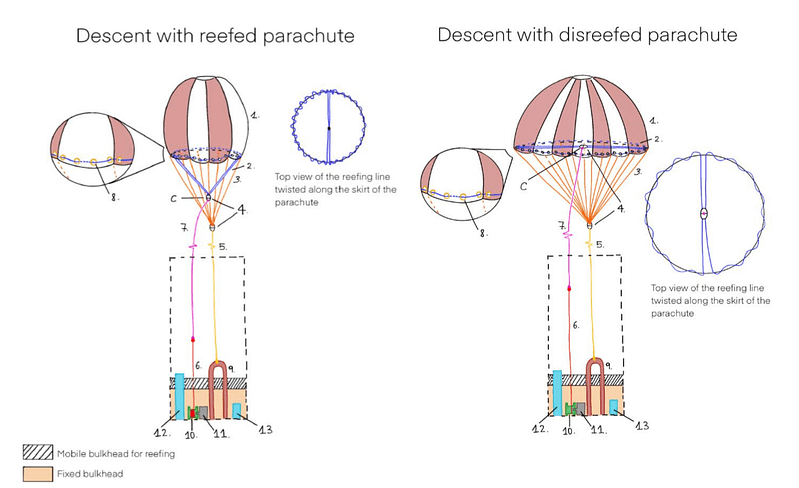
Once the apogee is reached, the parachute will be expelled by a CO2 charge. The newly ejected parachute will have a reduced base diameter in such a way as to create a resistance on theair equivalent to that which a parachute would have with aarea equal to 10% of its total area. This is made possible by a rope system that passes through theinside the base circumference of the parachute (reefing line) and is connected directly to the parachute compartment.
Inside the compartment, this rope is held in a spool (control line) which, connected to a gear motor, allows its release to be controlled. As a result, the parachute will descend in its drogue configuration up to altitude of about 800 meters with a speed of 23 m/s. At this point, the gear motor will be activated and will gradually begin to unroll the control line, allowing an increase in the effective area of the parachute. In about 36 seconds, the parachute will switch to the main configuration, i.e. aFull opening, where the descent speed will instead be 7.5 m/s.
JUNO - THE GROUP
The “JUNO” project emerged from the desire to explore new innovative ideas and study their applications. Currently, JUNO has 28 members, all students in the second and third year of bachelor’s degrees, mainly in Aerospace Engineering. This project offers students the opportunity to study theopportunities to put into practice the theoretical knowledge acquired during the courses in Aerodynamics, Applied Mechanics, Solid Mechanics, Aerospace Constructions and Physics. In addition, there is ain-depth training in theuse of software such as Autodesk Fusion 360, Ansys, Matlab, and OpenRocket. Without a doubt, JUNO represents aan important opportunity for each student to develop their own feeling of belonging to the engineering profession.