


Medusa is Sapienza Rocket Team’s competition rocket for the 2026 International Rocket Engineering Competition (IREC), held in Midland, Texas.
Built around a fully pyrotechnic-free recovery system and in-house avionics, it represents the team’s most advanced SRAD platform to date.
During the competition launch, our commercial motor experienced a CATO shortly after liftoff, cutting the flight well short of our target altitude. However, every single one of our student-developed subsystems performed exactly as designed: flight computer, airbrakes, CO₂ expulsion system, and parachutes.
Medusa carried a 3U CubeSat payload housing vibration-driven active matter robots, tracked in real time through a combination of Hall-effect sensors and phototransistors. This payload earned SRT third place in the SDL Payload Challenge at IREC 2026.


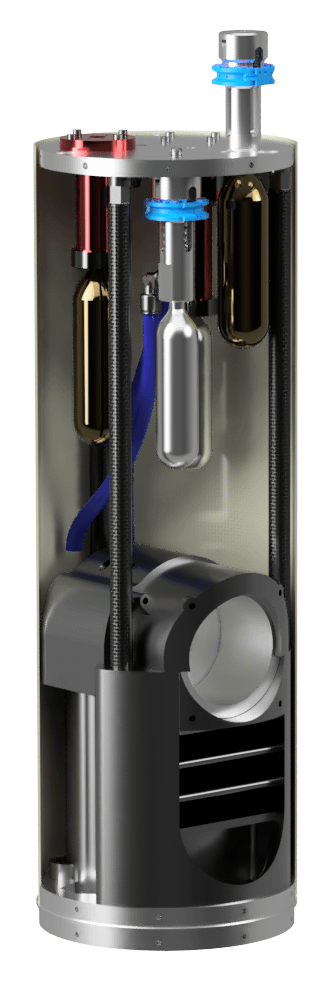
Medusa relies on a dual-deployment recovery system built around a pyroless, CO₂-based architecture rather than traditional pyrotechnics: a deliberate choice that avoids the handling and sourcing constraints of black powder while keeping performance consistent at altitude. The system is built on full SRAD/COTS redundancy, with two independent chains driving each deployment event.
At apogee, a ringslot drogue parachute is ejected laterally through the body tube by a piston-driven mortar: the SRAD system “Mulerna-HPP” punctures a CO₂ cartridge with a spring-loaded punch and feeds the mortar through a sealed perforation chamber and dedicated pneumatic pipe, while an independent COTS CO₂ device (CDA) provides fully separate redundancy on its own pressurization path. Lower, at 1,400 ft AGL, the main annular parachute is deployed by separating the nosecone from the airframe, driven by the SRAD system “Mulerna H“, using the same spring-loaded punch principle to pressurize the bay directly, again backed up by an independent COTS CDA unit. The drogue chain runs on 20 g CO₂ primary / 25 g backup, while the main chain steps up to 25 g primary / 38 g backup. Because both chains are entirely decoupled in logic and pressurization path, failure of one never impairs the other, ensuring a safe, controlled descent under 11 m/s even in a degraded scenario.
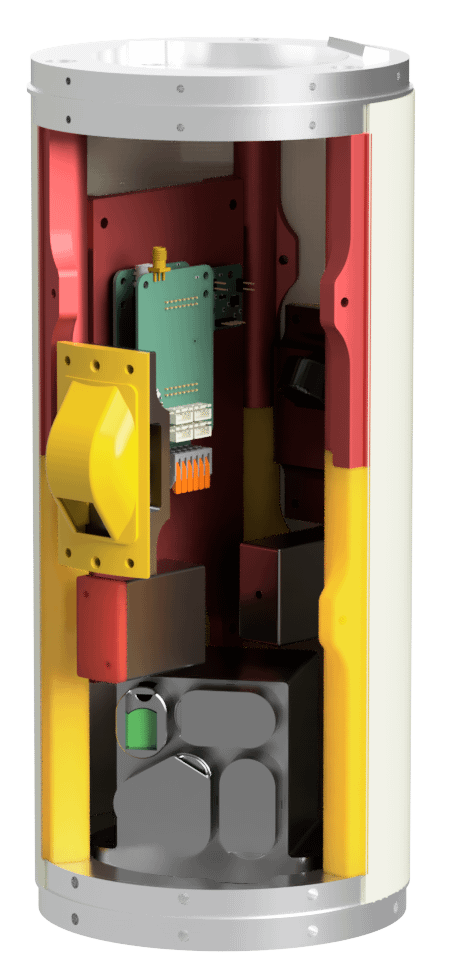
The Avionics Bay is home to the flight computers, batteries, and onboard cameras. To make access easier, the section uses a split shell configuration, where the body tube is divided along its length into three removable panels. This means the team can get to the electronics quickly even while the rocket is sitting on the launch rail. All the boards are mounted on a single 3D printed plate that’s fixed to the internal longerons, and each battery has its own protective housing to limit contact and reduce vibration related wear during flight. Two onboard cameras are mounted symmetrically on opposite shells to keep things aerodynamically balanced, one pointed toward the nosecone to capture drogue deployment, and the other aimed at the airbrakes to monitor how they perform in flight.
The bay runs two fully independent action pipelines, one COTS and one SRAD, completely separated in both logic and power. On the COTS side, a CATS Vega flight computer handles telemetry over 2.4 GHz LoRa FHSS, paired with an Altus Metrum Telemetrum tracker running on 70 cm GFSK. On the SRAD side, our in house flight computer Cerere is built around an RP2350 dual core M33 running at 150 MHz with 16 MB of flash, and reads an LPS22DF barometer alongside two LSM6DSV80x IMUs (±16 g / ±2000 dps) and an LIS2MDL magnetometer. Cerere is paired with a dedicated backpack module carrying a TESEO LIV4F GNSS receiver, accurate to 0.7 m, and an RAK3172 LoRa module for its own telemetry link. Cerere is the one driving main deployment, drogue deployment, and airbrake control, while the COTS chain serves as a full backup for parachute ejection, so no single failure can compromise the rocket’s recovery.
Medusa’s payload is a 3U CubeSat format experiment that studies active matter through self-propelled particles. It’s housed inside a modified “Build-a-CubeSat” structure and contains four octagonal arenas, each hosting a Hexbug, a small stick slip robot powered by an eccentric rotating mass motor. The Hexbugs get their power externally through copper plated PCB floors, so there’s no need for an onboard battery at all. The goal of the experiment is to see how the different phases of flight affect the Brownian motion and path chirality of these particles. To track their position, the team built two independent sensing systems: a grid of 32 three dimensional Hall effect sensors under the arena floor, which interpolates position from the Hexbug’s magnetic field, and an array of 204 phototransistors around each arena wall, which triangulates position using four directional LEDs mounted on the Hexbug itself. Having two separate tracking methods gave the team redundant, high resolution data throughout the whole flight.
This work was recognized at IREC 2026, where the payload earned 3rd place in the SDL Payload Challenge.


Medusa’s airbrakes are what give the rocket active altitude control, letting it correct for real world variations in the ascent and target its 10,000 ft apogee precisely.
Mechanically, the system uses a cam and carriage mechanism that turns the servomotor’s rotation into a linear motion of four petals. The cam has four radial arms, each ending in a bronze pin that rides along curved, diverging grooves cut into the petals, so as the cam turns the pins push the petals radially outward. A self lubricating Teflon bushing sits between the cam and the gear train to keep rotational friction low throughout the burn.
On the control side, the airbrakes activate once the rocket drops below Mach 0.8 during the coasting phase, since that’s the only window where active control is allowed under competition rules. The team formulated the problem as a Model Predictive Control strategy, solving a convex optimization problem onboard in real time to track a reference trajectory toward the target apogee. The controller runs at 6 Hz, taking velocity and altitude estimates from the onboard Kalman filter and recomputing the optimal airbrake extension at every step, with only about 50 milliseconds of delay from sensor reading to actuation. In Monte Carlo simulations run across a wide range of dispersions, 95% of trajectories landed within 10 meters of the 3,048 meter target apogee, showing just how tight the achievable control margin really is.
The four fins sit in a modular Fin Canister, made up of four CNC-machined 6061 aluminum rings bolted to the airframe just above the Boat-tail. This setup lets the fins be installed and secured with radial bolts only after the motor has been integrated, which simplifies the final assembly sequence quite a bit. Structurally, each fin is built as a carbon-fiber sandwich panel, with prepreg skins wrapped around a Koridion core. Koridion is an active material that expands during curing, so it presses each ply firmly against the mold from the inside out. This same property let the team embed an aluminum insert directly into the core for the threaded fastening points, keeping the fins light and stiff while holding up to repeated assembly and disassembly without wearing down the threads. Each fin also uses a custom-designed airfoil, refined through dedicated CFD analysis to get the best aerodynamic performance and flutter margin across the whole flight envelope.
Check out our IREC Podium Session for more details about the process:


